
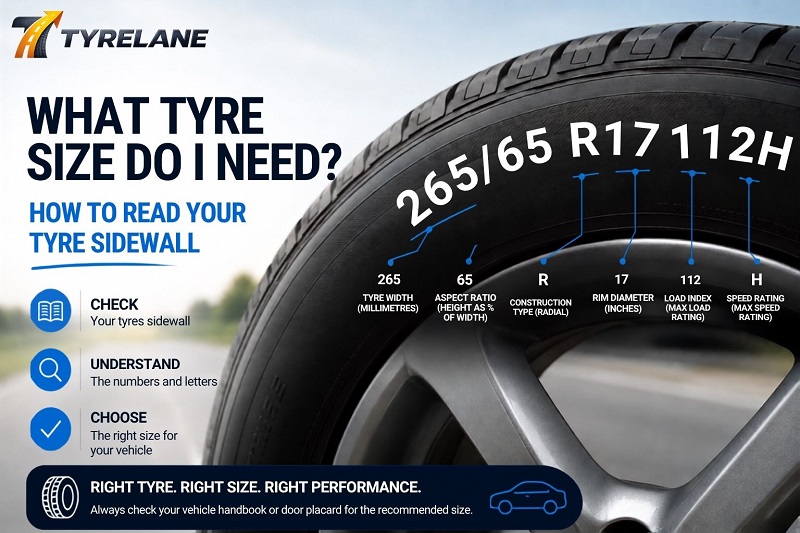
Choosing the correct tyre size is essential when replacing your car tyres. But tyre sidewalls can look confusing, especially when you see markings such as 265/65R17 112H.
These numbers and letters provide important information about the tyre, including its width, profile, construction, wheel size, load capacity and speed rating. Understanding them can help you make a more informed decision when buying new tyres.
Where Can You Find Your Tyre Size?
Your current tyre size is usually printed clearly on the tyre sidewall. You may see a marking similar to: 265/65R17 112H
You can also find your vehicle’s recommended tyre specifications on the vehicle placard, owner’s manual or manufacturer’s specifications.
If you’re replacing your tyres, it’s important to check the recommended specifications rather than choosing a tyre based only on appearance or price.
How to Read Tyre Size Numbers
Let’s break down the example 265/65R17 112H.
265 – Tyre Width
The first number represents the tyre’s nominal section width in millimetres.
In this example, 265 indicates a nominal tyre width of 265 mm.
Tyre width can affect the vehicle’s handling, road contact and overall driving characteristics, so it is important to use a size appropriate for your vehicle.
65 – Aspect Ratio
The second number is the tyre’s aspect ratio, expressed as a percentage.
A rating of 65 means the sidewall height is approximately 65% of the tyre’s nominal width.
A lower aspect ratio generally means a shorter sidewall, while a higher aspect ratio provides a taller sidewall.
R – Radial Construction
The letter R indicates radial construction.
Radial tyres are widely used on modern passenger cars, SUVs, 4WDs and many other vehicles. The internal construction helps provide the combination of stability, handling and durability expected from modern tyres.
17 – Wheel Diameter
The number following the construction type indicates the wheel diameter the tyre is designed to fit.
In R17, the 17 means the tyre is designed for a 17-inch wheel.
This is important because a tyre must be correctly matched to the wheel diameter.
What Do 112H Mean on a Tyre?
The numbers and letters after the main tyre size provide additional information.
112 – Load Index
The 112 is the tyre’s load index. It identifies the maximum load capacity of the tyre under specified conditions.
When choosing replacement car tyres, the appropriate load index is important, particularly for SUVs, 4WDs, vans and vehicles that regularly carry passengers or heavy loads.
H – Speed Rating
The letter H represents the tyre’s speed rating. It indicates the maximum speed capability of the tyre under specified test conditions.
Speed ratings should not be considered separately from the vehicle manufacturer’s recommendations. Always select tyres with specifications appropriate for your vehicle.
Is Tyre Size the Same for Every Vehicle?
No. Tyre sizes vary between different vehicles, models and variants. Some vehicles can also have different specifications for the front and rear axles.
Before ordering tyres online, check the vehicle placard, owner’s manual or current tyre specifications to confirm the correct fitment.
You can also search by your vehicle’s make, model, year and series if you are unsure about the appropriate tyre size.
Can You Change Your Tyre Size?
Changing from the manufacturer’s recommended tyre size should not be done simply because another option looks better or is cheaper.
An incorrect tyre size can potentially affect handling, ride characteristics, clearance and speedometer readings. It may also create compliance or safety concerns.
If you are considering a different tyre size, speak with a qualified tyre professional and confirm that the proposed size is suitable for your vehicle and complies with applicable requirements.
Choosing the Right Tyres for Your Driving Needs
Tyre size is only one factor to consider when choosing new tyres.
You should also think about how and where you drive. For example, everyday drivers may need standard passenger tyres, while SUV and 4WD owners may benefit from highway, all-terrain or mud-terrain tyres, depending on their driving conditions.
Drivers who regularly carry heavy loads should also pay close attention to load ratings and select tyres designed for their vehicle and application.
Buy the Right Tyres Online
Once you know your tyre size, finding suitable replacement tyres becomes much easier.
Tyrelane allows Australian drivers to search for tyres by tyre size or vehicle, compare different options and arrange delivery and fitting. Its network includes more than 800 fitting partners across Australia, with workshop and selected mobile fitting options available.
If you’re ready to replace your tyres, you can find your tyres online with Tyrelane by entering your tyre size or vehicle details.
Conclusion
Understanding your tyre sidewall doesn’t have to be complicated. A marking such as 265/65R17 112H tells you the tyre’s width, aspect ratio, construction, wheel diameter, load index and speed rating.
Before buying new tyres, always confirm the recommended specifications for your vehicle. Choosing the correct tyre size is an important first step towards finding tyres that suit your vehicle, driving conditions and everyday needs.
Leave a Reply
You must be logged in to post a comment.